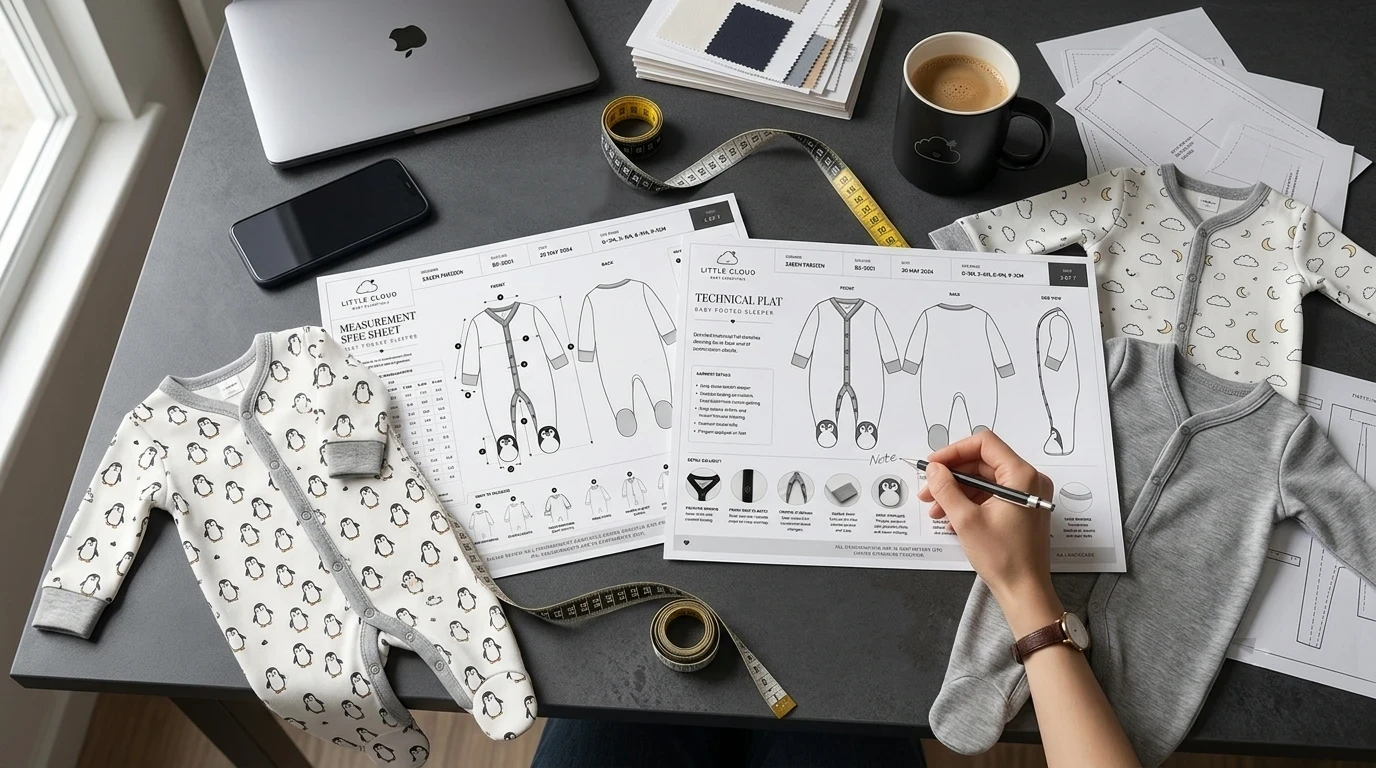
If you have ever sent a sketch to a factory and gotten back a sample that looked nothing like what you imagined, the problem was probably not the factory. It was almost certainly the absence of a tech pack.
A tech pack is the single most important document in the entire production process, and it is also the one most new brands underestimate. It is not a nice to have. It is the difference between a factory understanding exactly what to build and a factory guessing at what you meant.
This guide breaks down exactly what a tech pack is, what belongs in one, and why no serious manufacturer will move into production without it.
Table of Contents
What is a tech pack, exactly
Why your manufacturer needs one
What goes into a tech pack
Tech pack vs spec sheet vs mood board
How to create a tech pack step by step
Common tech pack mistakes
Tech pack checklist
Frequently asked questions
What Is a Tech Pack, Exactly?
A tech pack, short for technical package, is a detailed document that communicates every specification a manufacturer needs to produce a garment exactly as designed. It typically includes flat sketches, measurements, fabric and trim details, construction notes, colourways, and labelling instructions, all organised into a single reference file for the factory.
Think of it as the architectural blueprint for your garment. An architect does not hand a builder a photo of a beautiful house and say "make this." They hand over detailed drawings with exact measurements, materials, and structural notes. A tech pack does the same job for clothing.
Without it, a factory is left to interpret your vision based on guesswork, and guesswork at scale is expensive. A small misunderstanding on a single sample becomes a costly, time consuming problem once it is multiplied across a bulk order of a thousand units.
Why Your Manufacturer Needs One
There are four concrete reasons a tech pack is non negotiable once you move past the idea stage.
It removes ambiguity: Verbal descriptions and reference photos leave too much room for interpretation. A tech pack specifies exact measurements, exact fabric weights, and exact construction methods, so there is nothing left to guess at.
It protects your quality control: When you have a documented spec for every measurement and detail, you have a clear standard to check finished garments against. Without that standard, "quality control" becomes a subjective opinion rather than a measurable process.
It speeds up the sampling process: Factories that receive a complete tech pack can usually produce an accurate first sample in fewer rounds. Vague briefs typically mean three, four, or five rounds of corrections before a sample is even close to right, and every round adds weeks to your timeline.
It protects you in disputes: If a finished garment does not match what was agreed, a tech pack is your evidence. It is a signed, dated reference of exactly what was ordered. Without one, you have no real basis to request a redo or refuse a shipment.
Most established factories will simply decline to quote a bulk order without one. If a manufacturer offers to skip this step and move straight to production, treat that as a warning sign rather than a convenience.
What Goes Into a Tech Pack
A complete tech pack is made up of several distinct sections. Here is what each one covers.
1. Flat Sketch (Technical Drawing)
A clean, proportionate line drawing of the garment from the front, back, and any relevant side or detail views. This is not a fashion illustration. It is a flat, two dimensional technical drawing that shows construction lines, seams, and design details clearly.
2. Bill of Materials (BOM)
A complete list of every physical component in the garment. This includes the main fabric, lining, interfacing, zippers, buttons, drawstrings, elastic, labels, hangtags, and packaging materials. Each item should include the supplier, material composition, and colour reference.
3. Measurement Specifications (Spec Sheet)
A grid of exact measurements for every size you are producing, covering points like chest width, body length, sleeve length, shoulder width, and hem width. This section also includes a tolerance range, usually plus or minus 0.5 to 1 centimetre, which gives the factory an acceptable margin during cutting and sewing.
4. Colourways
Every colour variation of the garment, referenced using Pantone codes rather than descriptive names. "Navy blue" means something different to everyone. Pantone 19-4023 TCX means the same thing to everyone, including the dye house.
5. Construction Details
Notes on stitch type, seam allowance, seam finishing (overlocked, bound, French seam), and any reinforcement details like bartacking at stress points. This section tells the factory's pattern makers and sewing line exactly how the garment should be built, not just what it should look like.
6. Labelling and Packaging
Placement and specifications for woven labels, care labels, hangtags, and any barcode or polybag requirements. Retailers and marketplaces often have specific compliance requirements here, so this section matters more than founders expect.
7. Grading Rules
Instructions for how measurements scale up and down across your size range. If your sample is made in a medium, grading rules tell the factory exactly how much to add or subtract for small, large, and extra large.
8. Revision History
A simple log noting what changed between sample rounds and when. This keeps everyone, including you, aligned on which version of the garment is current.
Tech Pack vs Spec Sheet vs Mood Board
These three documents often get confused, but they serve completely different purposes in the design process.
Document | Purpose | Used By |
|---|---|---|
Mood board | Communicates aesthetic direction, colour palette, and inspiration | Designers, early concept stage |
Spec sheet | A single component of the tech pack focused on exact measurements | Pattern makers, factory technicians |
Tech pack | The complete technical blueprint covering construction, materials, measurements, and labelling | Manufacturers, quality control teams |
A mood board tells a factory how a garment should feel. A tech pack tells a factory exactly how to build it. You need both at different stages, but only one of them is required before a factory will quote your production.
How to Create a Tech Pack Step by Step
Step 1: Start with your flat sketch: Either draw this yourself using a vector tool like Adobe Illustrator, or work with a technical designer who specialises in flats. Software like Adobe Illustrator, CLO 3D, or dedicated tech pack platforms like Tech Pack Maker are common choices in the industry.
Step 2: Build your measurement spec: Take a well fitting reference garment and measure it at every key point: chest, length, sleeve, shoulder, hem, and so on. Build this into a grid covering your full size range, with tolerances included.
Step 3: Document your bill of materials: List every fabric, trim, and component with supplier details and exact colour references. If you do not yet have a fabric supplier, your sourcing partner can often help match you to one based on your spec.
Step 4: Write your construction notes: Be specific about seam types, stitch details, and any reinforcement. If you are unsure of the correct technical language, reference a similar existing garment and describe what you see as precisely as possible.
Step 5: Add labelling and packaging specs: Include label artwork, placement diagrams, and any polybag or hangtag requirements.
Step 6: Get it reviewed before sending it out: A technical designer or your sourcing partner can review your draft tech pack for gaps before it reaches the factory. Catching an error here costs you nothing. Catching it after a sample round costs you weeks.
If building this from scratch feels overwhelming, this is exactly the kind of work a sourcing partner like Kloth Source handles as part of onboarding a new brand into production. You do not need to become a technical designer overnight. You need a complete, accurate document, however it gets built.
Common Tech Pack Mistakes
Vague measurements: Listing "medium" without exact centimetre or inch measurements gives the factory nothing concrete to cut to.
Missing tolerances: Without a stated tolerance, even a well made garment can fall outside your expectations on a technicality, because fabric and cutting naturally have small variances.
Inconsistent colour references: Using a hex code from a screen instead of a Pantone code from a physical swatch book often leads to colour mismatches, since screens and printed fabric do not render colour the same way.
Leaving out packaging and labelling: Brands often focus entirely on the garment and forget that label placement, care instructions, and packaging are part of what gets manufactured too.
Not updating the revision history: When changes happen after the first sample, and they almost always do, failing to document them clearly leads to confusion about which version is actually being produced.
Tech Pack Checklist
Use this as a quick reference before sending your tech pack to a manufacturer.
Front, back, and detail flat sketches
Complete bill of materials with suppliers and compositions
Full size range measurement spec with tolerances
Pantone colour references for every colourway
Construction and stitch details
Seam finishing specifications
Label and hangtag placement diagrams
Packaging and polybag requirements
Grading rules across your size range
Revision history log
Frequently Asked Questions
What is a tech pack used for?
A tech pack is used to communicate the complete technical specification of a garment to a manufacturer. It includes flat sketches, measurements, materials, construction details, and labelling instructions, giving the factory everything needed to produce an accurate sample and consistent bulk order without relying on guesswork.
Do I need a tech pack to manufacture clothing?
Yes, in almost all cases. Most established manufacturers will not quote or begin sampling without one, since it is the only reliable way to ensure the factory understands exactly what to build. Skipping this step typically leads to inaccurate samples, repeated revision rounds, and longer production timelines.
What software is used to make a tech pack?
Common tools include Adobe Illustrator for flat sketches, dedicated tech pack software such as Tech Pack Maker or Gerber AccuMark, and 3D design platforms like CLO 3D. Many brands also start with structured templates in Excel or Google Sheets for the measurement spec and bill of materials sections before formatting the full document.
How much does it cost to make a tech pack?
Costs vary depending on garment complexity and who builds it. A freelance technical designer typically charges between $50 and $200 per style, while more complex garments with multiple components can run higher. Many sourcing partners and manufacturers include tech pack development as part of their onboarding service for new brands.
Can a manufacturer create a tech pack for me?
Some manufacturers and most sourcing partners offer tech pack creation as a service, particularly for brands without an in house design team. This usually involves a fitting session or detailed brief, followed by a draft tech pack for your review and approval before sampling begins.
What is the difference between a tech pack and a spec sheet?
A spec sheet is one component within a tech pack, focused specifically on garment measurements across a size range. A tech pack is the complete document, including the spec sheet along with flat sketches, materials, construction notes, and labelling details.
Building Your First Tech Pack?
A tech pack is not just paperwork. It is the foundation that determines whether your sample comes back looking like your vision or like a rough guess.
At Kloth Source, tech pack development is part of how we onboard every new brand into production. Our team works directly with you to translate your concept into a complete, manufacturer ready document, covering everything from flat sketches and measurement specs to labelling and packaging requirements. From there, we manage sampling, factory allocation, and quality control through our network of WRAP and SEDEX certified factories across Bangladesh, China, Vietnam, and India.
If you are ready to turn your design into a production ready spec, get in touch with our team and we will walk you through the process.
